Typing the best dental implant doctor near me into a search engine is often the first step after losing a tooth or being told that an extraction may be necessary. Location matters, particularly because implant treatment involves assessment, surgery, restoration and follow-up. Clinical planning, however, deserves greater attention than distance alone.
Dental implants interact with bone, gums, neighbouring teeth and the patient's bite. Provider selection should therefore focus on how these factors are assessed and managed.
Implant planning should begin before surgery
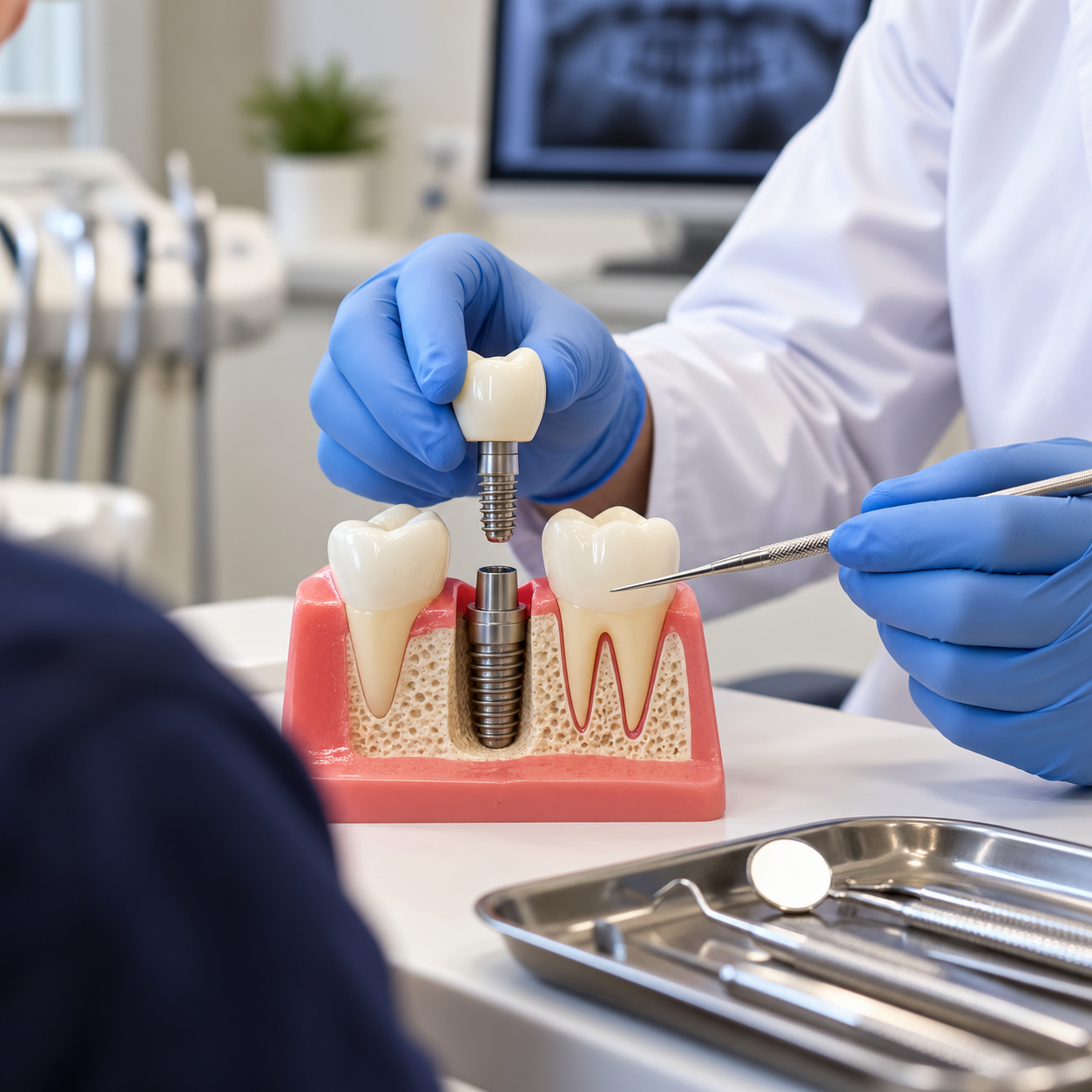
A dental implant is an artificial tooth root, usually made from a biocompatible material, that is placed into the jawbone and later supports a crown, bridge, or denture restoration.
Before recommending one, the clinician needs to determine whether an implant is actually the preferred option.
Assessment may include:
- Medical and dental history
- Gum health
- Bone quantity and quality
- Available space
- Condition of neighbouring teeth
- Bite forces
- Smoking history
- Existing infection
- Relevant three-dimensional imaging when indicated
This information influences implant position, dimensions, surgical complexity and restorative planning.
Ask who is planning the final tooth
Successful implant treatment is not only about placing a fixture in bone. Its position needs to support the final restoration.
Poor positioning can make the crown difficult to clean, affect appearance, or create unfavourable loading.
For front teeth, gum contours and aesthetic expectations can make planning particularly demanding. In back teeth, functional loading and available bone become major considerations.
The surgical and restorative stages should therefore be coordinated from the beginning.
Understand whether additional procedures are required
Some patients have enough healthy bone for straightforward implant placement. Others may require bone augmentation or another preparatory procedure.
An extraction may sometimes be combined with implant placement, while other cases benefit from a healing period before implantation.
There is no single timeline that applies to every patient.
What recovery usually involves
After implant surgery, temporary swelling, tenderness and minor bleeding can occur. Many people return to routine activities relatively quickly after uncomplicated treatment, although strenuous activity may need to be limited according to postoperative instructions.
The implant then requires a biological healing period before it can support the planned restoration in many treatment protocols.
Patients should distinguish this healing phase from the few days of initial surgical discomfort.
Benefits and potential risks
Implants can replace missing teeth without requiring conventional preparation of neighbouring healthy teeth. They can also provide support for fixed restorations or help stabilize certain dentures.
Risks can include infection, failure of integration, gum or bone loss around the implant, damage to nearby anatomical structures, mechanical complications and aesthetic problems.
Smoking, poorly controlled oral disease and inadequate plaque control can adversely affect outcomes.
Questions to ask before proceeding
Patients comparing implant providers can ask:
- What diagnostic imaging is required?
- Is there enough bone for the planned implant?
- Will grafting be necessary?
- How will the final crown be designed?
- What is the expected treatment sequence?
- What maintenance will the implant require?
- Which individual risk factors apply to me?
- What happens if integration does not occur as planned?
Dr. Nair's Dental Care and Implant Center in Kothrud serves patients from Pune, Maharashtra, who are evaluating implant-based replacement for missing teeth.
Frequently asked questions
Is implant surgery painful?
Local anaesthesia is commonly used during placement. Postoperative discomfort varies with the procedure.
How long does an implant last?
There is no guaranteed lifespan. Hygiene, gum health, smoking, bite forces, medical factors and maintenance influence longevity.
Can implants develop gum problems?
Yes. Tissues around implants require ongoing cleaning and professional monitoring.
Is an implant always better than a bridge?
No. Both can be appropriate. The condition of neighbouring teeth, bone, patient preferences and clinical circumstances influence the choice.
The useful result of a “near me” search is therefore not simply the closest appointment. It is finding a provider who can explain the complete implant plan from diagnosis through long-term maintenance.
Keywords