A missing tooth involves more than a visible gap: the jawbone changes, neighbouring teeth can become harder to clean, and chewing forces shift. By the end, you will understand the implant parts, treatment timeline, health requirements, restoration choices, and maintenance demands that determine whether implants fit your situation.
Key takeaways
- An implant replaces the tooth root; an abutment connects it to the crown.
- Healing and bone integration can make treatment take several months.
- Healthy gums, adequate bone, and controlled medical conditions support suitability.
- Choose among an implant, bridge, or implant-supported denture based on your needs.
How an Implant Replaces the Missing Tooth
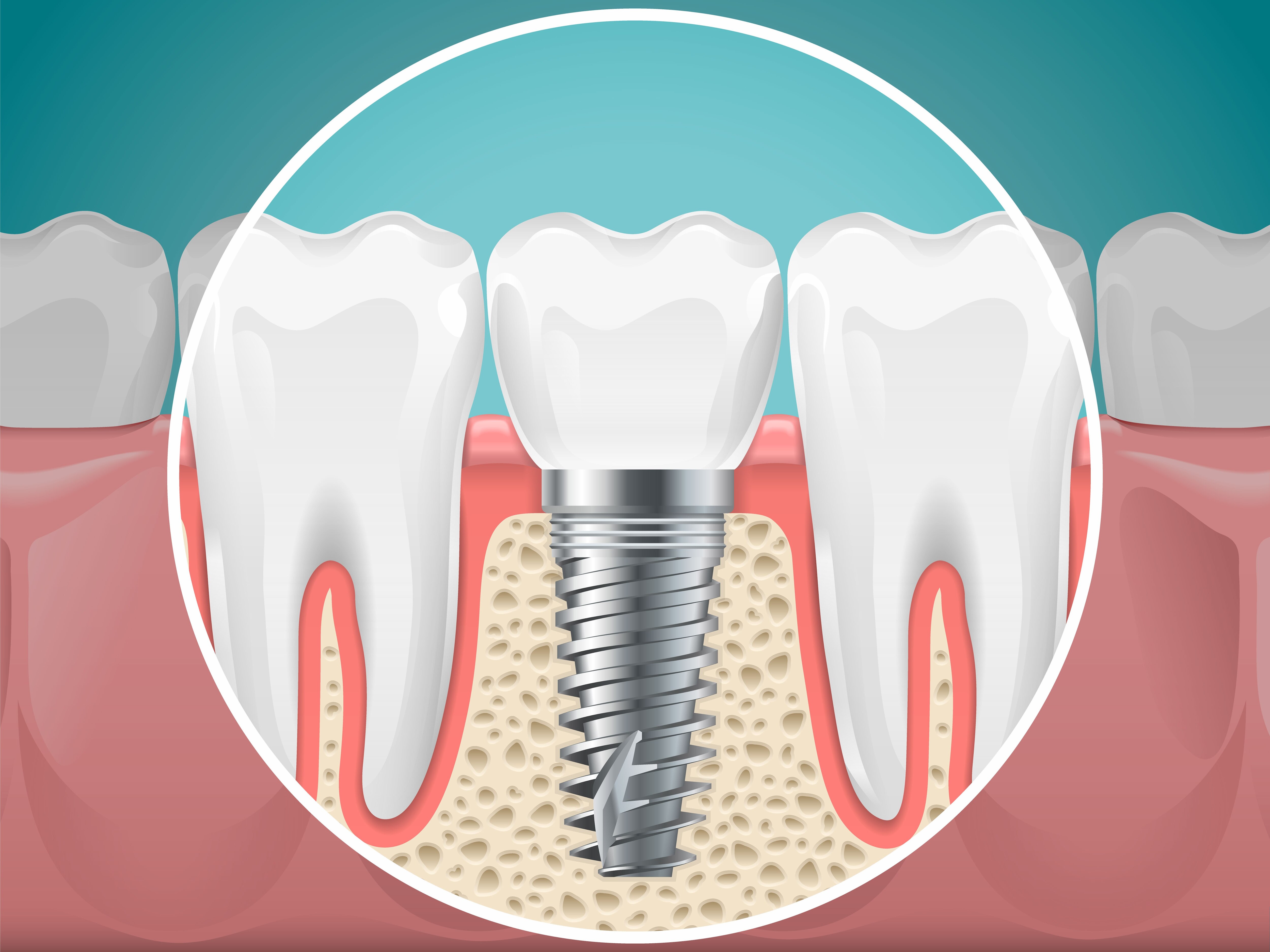
A dental implant is not a complete tooth by itself. The replacement has three connected parts:
- A titanium implant fixture sits inside the jawbone and replaces the missing root.
- An implant abutment connects the fixture to the restoration through the gum.
- An implant crown, bridge, or denture provides the visible tooth surface, restoring chewing and smile appearance.
The fixture gives the replacement stability, but it cannot chew or show above the gum on its own. The abutment transfers biting forces, while the crown or other prosthesis supplies the shape, colour, and contact needed for eating and speaking.
Front-tooth appearance depends on more than successful bone integration. The dentist must plan the implant position, gum contour, papillae between teeth, ridge shape, and crown design. Poor positioning, gum recession, a missing papilla, a thin ridge, or gray show-through can leave an unattractive result even when the implant is firm.
Jawbone loss after extraction commonly reduces the ridge’s width and height. An implant can help maintain bone around its site, but it cannot rebuild bone already lost without additional treatment, such as bone grafting. The final result therefore depends on both the implant components and the condition of the surrounding bone and gums.
What Happens During Treatment and How Long It Takes
Most dental implant treatment stages take months, not one appointment, because bone healing and laboratory fabrication cannot be rushed.
1. Examination starts with your medical history, oral examination, gum assessment, and treatment goals. Dental X-rays show the teeth and jaw; a 3D cone-beam CT is added when implant position, anatomy, or bone volume needs three-dimensional planning.
2. The dentist removes a damaged or infected tooth when extraction is needed. An implant may be placed immediately in the extraction socket, but only after assessing the socket and achieving suitable stability.
3. Implant placement involves inserting the titanium fixture into the jaw. The implant healing time then allows bone to grow directly against its surface, a process called osseointegration.
4. During healing, you may receive a temporary tooth after implant placement. It can be removable or fixed, but immediate provisionalization requires primary stability, suitable bone and gum tissue, and controlled biting forces.
5. After integration, the dentist exposes the implant when necessary and attaches the abutment, which supports the restoration above the gum.
6. The dental laboratory fabricates the final crown, bridge, or denture. Your dentist checks its fit, bite, shape, and colour before delivery.
Immediate implant placement is not the same as immediate placement of a temporary tooth. Some patients receive neither on the day of extraction, and healing plus fabrication can add several months rather than producing a same-day replacement.
How Your Bone, Gums, and Health Affect Suitability
A dentist first checks whether the proposed implant position has enough ridge width and height to surround the fixture with stable bone. A 3D scan also shows sinus anatomy in the upper jaw, while examination measures gum thickness and identifies active infection, untreated decay, bleeding, or periodontal disease.
Bone grafting is considered when the ridge is too narrow or short, or when the sinus leaves insufficient bone for a prosthetically positioned implant. A dental implant bone graft is not automatic: it adds surgery, healing time, cost, and possible complications, including infection or graft failure. Sinus-related augmentation carries the same trade-offs.
Tell the dentist about:
- Smoking, vaping, smokeless tobacco, or recent tobacco use; smoking and implant failure are linked through poorer blood supply and healing.
- Diabetes that is not controlled; diabetes and dental implants can be compatible when blood glucose is well controlled and medically assessed.
- Poor oral hygiene, unreliable cleaning, or previous periodontitis. Treated disease does not rule out implants, but healthy gums for implants require ongoing monitoring.
- Previous jaw radiation, medicines affecting bone metabolism such as bisphosphonates or denosumab, and blood-thinning medicines such as anticoagulants or antiplatelets. Never stop these without the prescriber’s advice.
Active infection, uncontrolled illness, unreliable plaque control, or incomplete jaw growth can make surgery unsafe or poorly timed. In younger patients, growth status and implant site matter more than age; an implant cannot move with growing teeth and may become visibly lower than them.
Choosing One Implant, a Bridge, or an Implant-Supported Denture
One missing tooth does not automatically call for an implant. In a single-tooth implant versus bridge decision, weigh the health of neighbouring teeth against surgery, treatment time, initial cost, and future maintenance.
| Option | Main trade-off | When it makes sense |
|---|---|---|
| Single implant and crown | Avoids preparing adjacent teeth, but requires surgery, a longer sequence, higher initial cost, and maintenance | One missing tooth with adequate bone, manageable biting forces, and reliable cleaning |
| Conventional fixed bridge | Can be completed sooner, but requires reshaping neighbouring teeth and depends on their strength | One missing tooth beside sound teeth that can support the bridge |
| Implant-supported bridge | Uses fewer fixtures than one implant per missing tooth, but needs surgical placement and cleaning beneath the bridge | Several adjacent missing teeth with suitable bone and controlled bite forces |
| Fixed implant-supported restoration | Feels stable and is not removed by the patient, but costs more and demands meticulous cleaning | All teeth missing when bone, health, budget, and cleaning ability support it |
| Two-implant overdenture | Removable and usually more retentive than a conventional lower complete denture; attachments need replacement or adjustment | Complete lower-jaw tooth loss with suitable sites for two implants |
| Removable partial or complete denture | Lower initial cost and no implant surgery, but less retention and chewing stability; it must be removed for cleaning | Missing several or all teeth, especially when bone volume, health, or budget limits implants |
A removable partial denture comparison must include the condition of remaining teeth: clasps can add load, while extraction may eliminate support but reduce preservation options. Ask how bone volume, biting forces, cleaning ability, budget, and remaining teeth change the recommendation. Any overdenture still needs cleaning underneath.
What Implant Maintenance and Follow-Up Require
An implant is not maintenance-free or permanent. Years after placement, peri-implantitis can cause bleeding, suppuration, deeper probing depths, and progressive bone loss, leading to implant loss.
Your implant cleaning routine starts with daily brushing around the crown, bridge, or denture. Use an interdental brush, floss threader, specialized implant brush, or water flosser when contours trap plaque; your dentist can show which aid fits without injuring the gum.
Schedule periodic professional examinations, even when nothing hurts. The dentist checks gum bleeding, probing depths, bite, crown margins, and attachment stability, with radiographs when symptoms, examination findings, or baseline comparison indicate them. Problems can include crown fracture, screw loosening, loss of retention, or implant loss. Overdenture attachments also need adjustment or replacement.
Questions to ask an implant dentist include:
- Where will you position the implant, and do I need bone grafting?
- What temporary-tooth plan will I use, how long is the healing interval, and will the final restoration be a crown, bridge, fixed prosthesis, or overdenture?
- Which implant cleaning routine suits its contours, and when are reviews and radiographs due?
- How will smoking, diabetes, gum disease history, or my medicines change the plan?
Dr. Nair’s Dental Care and Implant Center can discuss these case-specific questions with a Pune dental team, but only an individual assessment can determine your maintenance needs.
Related service
Dental Implants to Transform Your Smile Dental Implants to Transform Your Smile What are Dental Implants? Imagine being able to smile, eat, and speak without thinking about the missing tooth at all. |
Frequently asked questions
What are the three parts of a dental implant?
A dental implant restoration has an implant post placed in the jawbone, an abutment that connects the post to the replacement tooth, and a crown, bridge, or denture that replaces the visible tooth.
How long does dental implant treatment take?
Treatment time depends on healing, bone integration, and any required procedures such as bone grafting. The process can take several months from implant placement to the final restoration.
What affects whether you are suitable for dental implants?
Your dentist assesses jawbone volume, gum health, oral hygiene, smoking, and medical conditions that affect healing. Bone grafting or gum treatment may be needed before placement.
Should you choose an implant, bridge, or implant-supported denture?
An implant replaces one tooth without preparing neighbouring teeth. A bridge uses adjacent teeth for support, while an implant-supported denture can replace several missing teeth with improved stability.
How do you maintain dental implants?
Brush twice daily with fluoride toothpaste, clean between teeth with floss or interdental brushes, attend recommended check-ups, and report bleeding, pain, looseness, or changes in your bite.